
Inventory Accuracy vs Inventory Assurance: What Is the Difference?
An inventory accuracy figure can look reassuring. The difficulty is knowing what actually sits behind it, and how the figure was calculated.
If a warehouse reports 99% inventory accuracy, an operations manager still needs to know how recently the stock was checked, what proportion of the warehouse was physically verified, whether high-level locations received the same scrutiny and how discrepancies were reconciled with the WMS.
That is the difference between inventory accuracy and inventory assurance. One is the reported outcome. The other is the evidence and control that tells you how much confidence to place in that outcome.
What is inventory accuracy?
Inventory accuracy is usually expressed as the degree to which system records match what is physically present. The exact calculation varies between organisations: some measure quantity accuracy, some location accuracy, some SKU accuracy and some combine several measures.
The number is useful, but on its own it does not explain how the result was produced. A warehouse could reach a strong accuracy figure from a recent wall-to-wall count, while still having limited visibility over what happens in the weeks that follow.
What is inventory assurance?
Inventory assurance is about the strength of the control behind the number. It asks whether the physical inventory is checked often enough, across enough of the operation, with evidence and a repeatable reconciliation process.
In practice, that means looking beyond “what was the accuracy result?” and asking whether the warehouse can demonstrate why the result should be trusted.
- Coverage: how much of the warehouse is actually being physically checked?
- Frequency: how long can a discrepancy remain undetected between checks?
- Evidence: is there a record of what was physically observed and when?
- Reconciliation: are observations consistently compared with WMS or ERP expectations?
- Exception ownership: are discrepancies investigated, resolved and prevented from recurring?
- Governance: can management see trends in coverage, exceptions and control performance over time?
Why a good WMS does not remove the need for physical verification
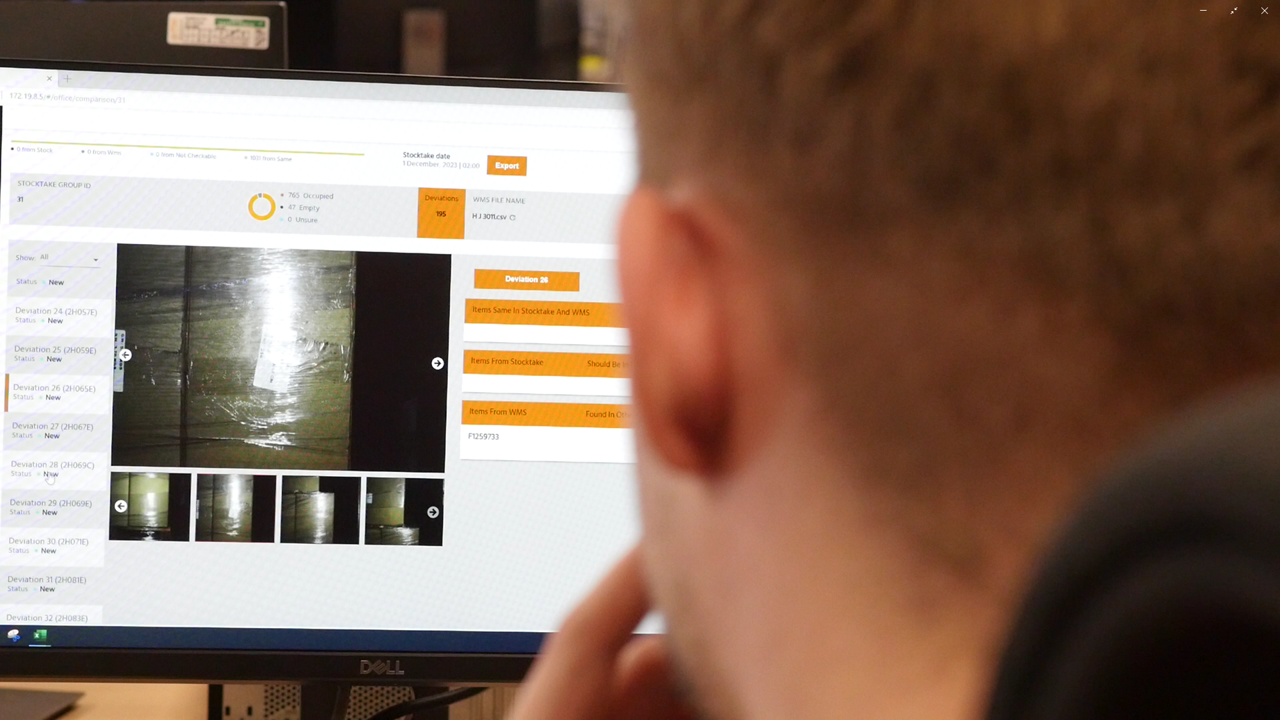
A Warehouse Management System is essential for recording stock movements, locations and transactions. But the WMS normally records what the operation tells it happened; it does not physically look into the rack and confirm that the pallet is still there.
That distinction matters. A scan can be missed, a pallet can be putaway into the wrong location, an identifier can be unreadable, or a movement can happen outside the expected process. The system record may remain perfectly logical while physical reality has moved on.
The gap between the system record and what has recently been physically verified is what RAWview describes as the Inventory Assurance Gap.
Why periodic stocktakes can create false confidence
A stocktake is valuable because it creates a point-in-time reconciliation. The problem is assuming that the same level of confidence remains indefinitely after the count is complete.
The reality is that as soon as normal warehouse activity resumes, new moves, picks, receipts and exceptions begin. The question is therefore not whether a warehouse ever checks its stock; it is whether the frequency and coverage of those checks are strong enough for the level of operational risk.
What stronger inventory assurance looks like
Stronger assurance does not mean counting everything every day. It means designing a repeatable verification process around the warehouse’s actual risk, complexity and operating model.
For some operations that may mean prioritising high-value or high-velocity zones. For others it may mean broad scheduled coverage across pallet locations so that discrepancies are surfaced earlier and the evidence exists to investigate them properly.
- Physical verification is part of business-as-usual rather than a crisis response.
- High-level and difficult-to-access locations are not consistently excluded because they are inconvenient to check.
- Unexpected or unreadable inventory is flagged rather than silently assumed to be correct.
- Coverage and exceptions are visible to the people responsible for inventory control.
- Recurring discrepancies are used to identify process weaknesses, not simply corrected and forgotten.
Where automation fits
Automation is useful when the limiting factor is the cost, frequency, safety or repeatability of physical data capture. Warehouse inventory drones and robotics can increase the amount of physical verification that can be performed without proportionately increasing manual counting effort.
The technology is not the assurance process by itself. The value comes from combining repeatable physical capture with WMS comparison, evidence, exception management and an operating model that keeps the control running over time.
Accuracy is the score. Assurance is the confidence behind it.
Warehouses will always need measures of inventory accuracy. The important shift is to stop treating the percentage as the whole story. For a practical framework, see our guide to how to improve warehouse inventory accuracy.
When coverage, frequency, evidence and reconciliation are visible as well, management has a much stronger basis for deciding whether reported inventory accuracy can be relied on by operations, finance, customers and auditors. Our warehouse inventory audit checklist sets out the controls that help demonstrate that confidence in practice.
Concluding thoughts
How strong are the controls behind your current inventory accuracy figure? Complete the free Inventory Assurance Health Check to assess verification coverage, reconciliation, exception management and governance in a few minutes.

An inventory accuracy figure can look reassuring. The difficulty is knowing what actually sits behind it, and how the figure was calculated.
If a warehouse reports 99% inventory accuracy, an operations manager still needs to know how recently the stock was checked, what proportion of the warehouse was physically verified, whether high-level locations received the same scrutiny and how discrepancies were reconciled with the WMS.
That is the difference between inventory accuracy and inventory assurance. One is the reported outcome. The other is the evidence and control that tells you how much confidence to place in that outcome.
What is inventory accuracy?
Inventory accuracy is usually expressed as the degree to which system records match what is physically present. The exact calculation varies between organisations: some measure quantity accuracy, some location accuracy, some SKU accuracy and some combine several measures.
The number is useful, but on its own it does not explain how the result was produced. A warehouse could reach a strong accuracy figure from a recent wall-to-wall count, while still having limited visibility over what happens in the weeks that follow.
What is inventory assurance?
Inventory assurance is about the strength of the control behind the number. It asks whether the physical inventory is checked often enough, across enough of the operation, with evidence and a repeatable reconciliation process.
In practice, that means looking beyond “what was the accuracy result?” and asking whether the warehouse can demonstrate why the result should be trusted.
- Coverage: how much of the warehouse is actually being physically checked?
- Frequency: how long can a discrepancy remain undetected between checks?
- Evidence: is there a record of what was physically observed and when?
- Reconciliation: are observations consistently compared with WMS or ERP expectations?
- Exception ownership: are discrepancies investigated, resolved and prevented from recurring?
- Governance: can management see trends in coverage, exceptions and control performance over time?
Why a good WMS does not remove the need for physical verification
A Warehouse Management System is essential for recording stock movements, locations and transactions. But the WMS normally records what the operation tells it happened; it does not physically look into the rack and confirm that the pallet is still there.
That distinction matters. A scan can be missed, a pallet can be putaway into the wrong location, an identifier can be unreadable, or a movement can happen outside the expected process. The system record may remain perfectly logical while physical reality has moved on.
The gap between the system record and what has recently been physically verified is what RAWview describes as the Inventory Assurance Gap.
Why periodic stocktakes can create false confidence
A stocktake is valuable because it creates a point-in-time reconciliation. The problem is assuming that the same level of confidence remains indefinitely after the count is complete.
The reality is that as soon as normal warehouse activity resumes, new moves, picks, receipts and exceptions begin. The question is therefore not whether a warehouse ever checks its stock; it is whether the frequency and coverage of those checks are strong enough for the level of operational risk.
What stronger inventory assurance looks like
Stronger assurance does not mean counting everything every day. It means designing a repeatable verification process around the warehouse’s actual risk, complexity and operating model.
For some operations that may mean prioritising high-value or high-velocity zones. For others it may mean broad scheduled coverage across pallet locations so that discrepancies are surfaced earlier and the evidence exists to investigate them properly.
- Physical verification is part of business-as-usual rather than a crisis response.
- High-level and difficult-to-access locations are not consistently excluded because they are inconvenient to check.
- Unexpected or unreadable inventory is flagged rather than silently assumed to be correct.
- Coverage and exceptions are visible to the people responsible for inventory control.
- Recurring discrepancies are used to identify process weaknesses, not simply corrected and forgotten.
Where automation fits
Automation is useful when the limiting factor is the cost, frequency, safety or repeatability of physical data capture. Warehouse inventory drones and robotics can increase the amount of physical verification that can be performed without proportionately increasing manual counting effort.
The technology is not the assurance process by itself. The value comes from combining repeatable physical capture with WMS comparison, evidence, exception management and an operating model that keeps the control running over time.
Accuracy is the score. Assurance is the confidence behind it.
Warehouses will always need measures of inventory accuracy. The important shift is to stop treating the percentage as the whole story. For a practical framework, see our guide to how to improve warehouse inventory accuracy.
When coverage, frequency, evidence and reconciliation are visible as well, management has a much stronger basis for deciding whether reported inventory accuracy can be relied on by operations, finance, customers and auditors. Our warehouse inventory audit checklist sets out the controls that help demonstrate that confidence in practice.
Concluding thoughts
How strong are the controls behind your current inventory accuracy figure? Complete the free Inventory Assurance Health Check to assess verification coverage, reconciliation, exception management and governance in a few minutes.
Client Testimonial


