
How the 2025/2026 Budget is Reshaping Warehouse Economics and Why Automation Is Now Essential
The 2025 Budgets have fundamentally changed the economics of warehouse operations. With business rates surcharges, employer National Insurance increases and minimum wage rises combining to add substantial operating costs to warehouses, automation is no longer be viewed as a 'nice to have' - it's a strategic imperative for survival.
For warehouse operators, distribution centres and fulfilment facilities, the financial pressure is mounting from multiple directions. Understanding these changes and responding strategically will determine which businesses thrive and which struggle to remain competitive in the years ahead.
Let’s break down the key budget changes affecting warehouse operations, explore their real-world impact through a practical scenario and examine how automation technologies like inventAIRy XL can help businesses not just survive, but gain a competitive advantage in this new economic landscape.
Understanding the Budget Changes
April 2025: Employer National Insurance Increases
From April 2025, employer secondary Class 1 National Insurance Contributions increased from 13.8% to 15%, whilst the secondary threshold reduced from £9,100 to £5,000. This creates a significant increase in workforce costs, particularly for labour-intensive warehouse operations employing 100+ staff.
For businesses with large workforces, this represents a substantial additional cost on every employee, from warehouse operatives to supervisors and management.
Autumn Budget 2025: Business Rates Surcharge
Large industrial properties with a rateable value above £500,000 face higher business rates from April 2026. This charge disproportionately impacts e-commerce and fulfilment centres in the logistics and warehouse sector.
These properties will face an additional 2.8p rate added to the standard multiplier, bringing it to 50.8p. For large distribution centres and fulfilment operations, this translates to tens of thousands of pounds in additional annual costs.
Minimum Wage Increases: Double Impact
Warehouses employing significant numbers of minimum wage workers - pickers, packers, auditors and general operatives - will see substantial labour cost inflation, compounded by the National Insurance increases.
The National Living Wage increased to £12.21 per hour in April 2025 and will rise again by 50p to £12.71 per hour in April 2026. The National Minimum Wage for 18-20 year olds will see a significant increase of 85p to £10.85 per hour from April 2026.
For warehouses with large teams of operatives, these increases represent a substantial ongoing cost burden.
Future Pressures To Be Aware Of
Whilst fuel duty has been frozen until September 2026, staged increases are planned from late 2026 onwards. Additional cost pressures include Insurance Premium Tax increases and Vehicle Exercise Duty rises for HGVs, with road pricing and EV charging infrastructure costs also on the horizon.
Example Scenario: Mid-Sized Distribution Warehouse
To understand the true impact of these changes, let's examine an example scenario for a singular mid-sized distribution warehouse.
Workings included at the end of this article.
Warehouse Profile
- Size: 100,000 sq ft warehouse
- Rateable value: £1,200,000 - based on 2024 average rent for commercial warehouses in England.
- Workforce: 120 employees
- 95 warehouse operatives (all 21 and over on National Living Wage)
- 20 supervisors and team leaders (£30,000 average salary)
- 5 management (£42,000 average salary)
Assumptions
- 35 hour work week per National Living Wage worker x 52 weeks = 1,820hrs/year
- All warehouse operative workers are 21 and over being paid National Living Wage
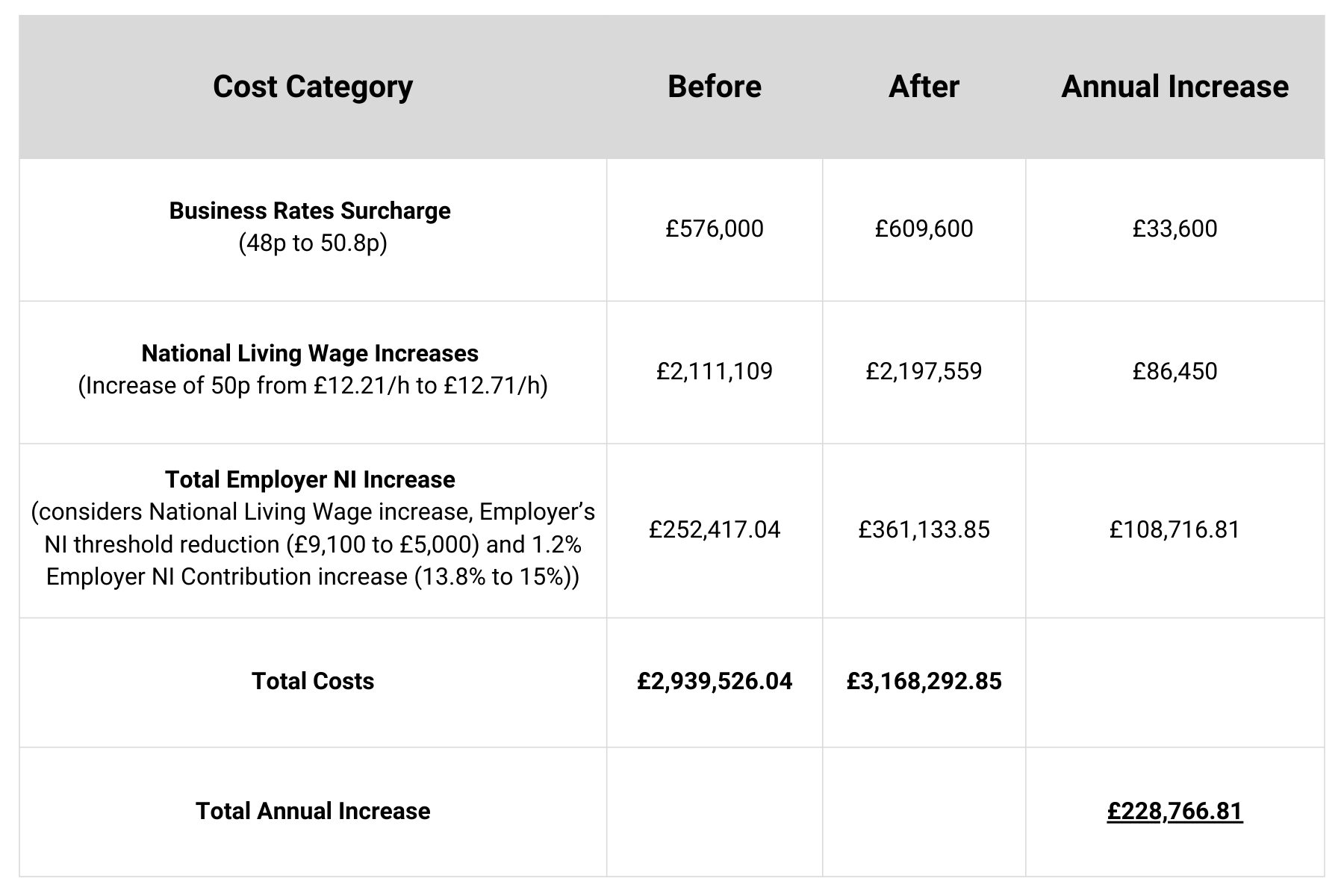
Annual Cost Increases
The Automation Imperative: How inventAIRy XL Delivers ROI
In this new economic landscape, warehouse automation is no longer about gaining a competitive edge, it's about maintaining viability. inventAIRy XL, RAWview's autonomous drone-based inventory management system, directly addresses the cost pressures outlined above.
Labour Cost Reduction
inventAIRy XL reduces labour hours for stock take audits by 60-80%, directly cutting the wage bill and associated National Insurance costs. Fewer audit staff required means lower ongoing expenses in both wages and employer NI contributions.
With the combined impact of minimum wage increases and higher NI rates, every hour of manual labour saved translates to greater cost savings than ever before.
Eliminating Equipment and Safety Costs
Traditional stock takes require access equipment such as cherry pickers, scissor lifts and manual counting teams. inventAIRy XL eliminates these requirements entirely, removing hire costs, maintenance expenses and associated health and safety risks.
Operational Flexibility
inventAIRy XL can conduct audits outside of working hours, minimising disruption to daily operations. This means warehouses can maintain productivity whilst achieving superior inventory accuracy, maximising revenue potential without additional labour costs.
Accuracy and Shrinkage Reduction
With 99.9% accuracy, inventAIRy XL dramatically reduces stock discrepancies and shrinkage. Better inventory control leads to improved planning, reduced waste and optimised stock levels – all contributing to healthier profit margins.
Accelerated ROI in the New Economic Reality
Whilst ROI for inventAIRy XL was typically achieved within 12 months, the rising labour costs and increased employer NI contributions mean this payback period is now accelerated.
The £228,766 in additional annual costs facing our example warehouse could be substantially offset by implementing inventAIRy XL. With labour cost savings, improved accuracy and operational efficiencies, the business case for automation has never been stronger.
Conclusion: Adapt or Fall Behind
The recent budgets have created a watershed moment for warehouse operations. The combined impact of business rates surcharges, employer NI increases and minimum wage rises means that maintaining the status quo is no longer financially viable for many operations.
Warehouse automation, particularly autonomous inventory management systems like inventAIRy XL, offers a clear path forward. By reducing labour costs, improving accuracy and enhancing operational efficiency, automation technologies don't just help businesses survive the new economic reality, they position them to thrive.
The question is no longer whether to automate, but how quickly you can implement solutions that deliver measurable ROI. In a landscape where operating costs are rising annually, standing still means falling behind.
For warehouse operators facing these challenges, the time to act is now. Automation is no longer a luxury - it's a strategic necessity for long-term success.
Want to learn more about the inventAIRy solution?
Book a discovery call with our team to find out how our inventory management system could support your warehouse operations.
Example Scenario Workings
Business Rates:
2.8p rate added to the standard multiplier of 48p bringing it to 50.8p.
- Rateable value of £1,200,000 based on England 2024 average rent for commercial warehouses.
- Additional 2.8p multiplier = £1,200,000 × 0.028 = £33,600
- Total business rate increase = £33,600
National Living Wage Increases:
National Living Wage for workers 21 and over will increase by 50p from £12.21/hr to £12.71/hr.
- 95 operatives moving from £12.21/hr to £12.71/hr
- 50p increase × 1,820 hours (52 weeks × 35 hours) = £910 per operative
- 95 operatives × £910 = £86,450
- Total increase in wages = £86,450
Employer NI:
2024-2025 Employer’s National Insurance secondary threshold was £9,100 per employee annually. 2025-2026 Employer’s National Insurance secondary threshold reduced to: £5,000 per employee annually
Additionally, in April 2025 the Employer National Insurance Contributions was raised from 13.8% to 15%.
Employer National Insurance Threshold Calculation
Before Wage Increase and Employer NI threshold reduction:
- 95 operatives at £22,222.20 (£12.21/hr x 1820hrs) = £2,111,109
- 20 supervisors at £30,000 = £600,000
- 5 management at £42,000 = £210,000
Total payroll before increases: £2,921,109
Taxable payroll for NI purposes (£9,100 allowance per employee - before Employer NI threshold reduction):
- Total Employer NI allowance: 120 employees × £9,100 = £1,092,000
- Taxable Employer NI payroll: £2,921,109 - £1,092,000 = £1,829,109
After Wage Increases and Employer NI threshold reduction:
- 95 operatives at £23,132.2 (£12.71/hr x 1820hrs) = £2,197,559
- 20 supervisors at £30,000 = £600,000
- 5 management at £42,000 = £210,000
Total payroll after increases: £3,007,559
Taxable payroll (£5,000 allowance per employee - after Employer NI threshold reduction):
- Total allowance: 120 employees × £5,000 = £600,000
- Taxable Employer NI payroll: £3,007,559 - £600,000 = £2,407,559
Employer National Insurance Contribution Addition:
- Total Employer NI Cost before wage increase, Employer NI threshold reduction and Employer NI Contribution increase: £1,829,109 x 13.8% = £252,417.04
- Total Employer NI Cost after wage increase, Employer NI threshold reduction and Employer NI Contribution increase: £2,407,559 x 15% = £361,133.85
- Total Employer NI increase: £361,133.85 - £252,417.04 = £108,716.81
Sources:
Local Government Association - Autumn Budget 2025: LGA Briefing
GOV.UK - National Minimum Wage and National Living Wage rates
Alan Boswell Group - Commercial Property Statistics 2025

The 2025 Budgets have fundamentally changed the economics of warehouse operations. With business rates surcharges, employer National Insurance increases and minimum wage rises combining to add substantial operating costs to warehouses, automation is no longer be viewed as a 'nice to have' - it's a strategic imperative for survival.
For warehouse operators, distribution centres and fulfilment facilities, the financial pressure is mounting from multiple directions. Understanding these changes and responding strategically will determine which businesses thrive and which struggle to remain competitive in the years ahead.
Let’s break down the key budget changes affecting warehouse operations, explore their real-world impact through a practical scenario and examine how automation technologies like inventAIRy XL can help businesses not just survive, but gain a competitive advantage in this new economic landscape.
Understanding the Budget Changes
April 2025: Employer National Insurance Increases
From April 2025, employer secondary Class 1 National Insurance Contributions increased from 13.8% to 15%, whilst the secondary threshold reduced from £9,100 to £5,000. This creates a significant increase in workforce costs, particularly for labour-intensive warehouse operations employing 100+ staff.
For businesses with large workforces, this represents a substantial additional cost on every employee, from warehouse operatives to supervisors and management.
Autumn Budget 2025: Business Rates Surcharge
Large industrial properties with a rateable value above £500,000 face higher business rates from April 2026. This charge disproportionately impacts e-commerce and fulfilment centres in the logistics and warehouse sector.
These properties will face an additional 2.8p rate added to the standard multiplier, bringing it to 50.8p. For large distribution centres and fulfilment operations, this translates to tens of thousands of pounds in additional annual costs.
Minimum Wage Increases: Double Impact
Warehouses employing significant numbers of minimum wage workers - pickers, packers, auditors and general operatives - will see substantial labour cost inflation, compounded by the National Insurance increases.
The National Living Wage increased to £12.21 per hour in April 2025 and will rise again by 50p to £12.71 per hour in April 2026. The National Minimum Wage for 18-20 year olds will see a significant increase of 85p to £10.85 per hour from April 2026.
For warehouses with large teams of operatives, these increases represent a substantial ongoing cost burden.
Future Pressures To Be Aware Of
Whilst fuel duty has been frozen until September 2026, staged increases are planned from late 2026 onwards. Additional cost pressures include Insurance Premium Tax increases and Vehicle Exercise Duty rises for HGVs, with road pricing and EV charging infrastructure costs also on the horizon.
Example Scenario: Mid-Sized Distribution Warehouse
To understand the true impact of these changes, let's examine an example scenario for a singular mid-sized distribution warehouse.
Workings included at the end of this article.
Warehouse Profile
- Size: 100,000 sq ft warehouse
- Rateable value: £1,200,000 - based on 2024 average rent for commercial warehouses in England.
- Workforce: 120 employees
- 95 warehouse operatives (all 21 and over on National Living Wage)
- 20 supervisors and team leaders (£30,000 average salary)
- 5 management (£42,000 average salary)
Assumptions
- 35 hour work week per National Living Wage worker x 52 weeks = 1,820hrs/year
- All warehouse operative workers are 21 and over being paid National Living Wage
Annual Cost Increases
The Automation Imperative: How inventAIRy XL Delivers ROI
In this new economic landscape, warehouse automation is no longer about gaining a competitive edge, it's about maintaining viability. inventAIRy XL, RAWview's autonomous drone-based inventory management system, directly addresses the cost pressures outlined above.
Labour Cost Reduction
inventAIRy XL reduces labour hours for stock take audits by 60-80%, directly cutting the wage bill and associated National Insurance costs. Fewer audit staff required means lower ongoing expenses in both wages and employer NI contributions.
With the combined impact of minimum wage increases and higher NI rates, every hour of manual labour saved translates to greater cost savings than ever before.
Eliminating Equipment and Safety Costs
Traditional stock takes require access equipment such as cherry pickers, scissor lifts and manual counting teams. inventAIRy XL eliminates these requirements entirely, removing hire costs, maintenance expenses and associated health and safety risks.
Operational Flexibility
inventAIRy XL can conduct audits outside of working hours, minimising disruption to daily operations. This means warehouses can maintain productivity whilst achieving superior inventory accuracy, maximising revenue potential without additional labour costs.
Accuracy and Shrinkage Reduction
With 99.9% accuracy, inventAIRy XL dramatically reduces stock discrepancies and shrinkage. Better inventory control leads to improved planning, reduced waste and optimised stock levels – all contributing to healthier profit margins.
Accelerated ROI in the New Economic Reality
Whilst ROI for inventAIRy XL was typically achieved within 12 months, the rising labour costs and increased employer NI contributions mean this payback period is now accelerated.
The £228,766 in additional annual costs facing our example warehouse could be substantially offset by implementing inventAIRy XL. With labour cost savings, improved accuracy and operational efficiencies, the business case for automation has never been stronger.
Conclusion: Adapt or Fall Behind
The recent budgets have created a watershed moment for warehouse operations. The combined impact of business rates surcharges, employer NI increases and minimum wage rises means that maintaining the status quo is no longer financially viable for many operations.
Warehouse automation, particularly autonomous inventory management systems like inventAIRy XL, offers a clear path forward. By reducing labour costs, improving accuracy and enhancing operational efficiency, automation technologies don't just help businesses survive the new economic reality, they position them to thrive.
The question is no longer whether to automate, but how quickly you can implement solutions that deliver measurable ROI. In a landscape where operating costs are rising annually, standing still means falling behind.
For warehouse operators facing these challenges, the time to act is now. Automation is no longer a luxury - it's a strategic necessity for long-term success.
Want to learn more about the inventAIRy solution?
Book a discovery call with our team to find out how our inventory management system could support your warehouse operations.
Example Scenario Workings
Business Rates:
2.8p rate added to the standard multiplier of 48p bringing it to 50.8p.
- Rateable value of £1,200,000 based on England 2024 average rent for commercial warehouses.
- Additional 2.8p multiplier = £1,200,000 × 0.028 = £33,600
- Total business rate increase = £33,600
National Living Wage Increases:
National Living Wage for workers 21 and over will increase by 50p from £12.21/hr to £12.71/hr.
- 95 operatives moving from £12.21/hr to £12.71/hr
- 50p increase × 1,820 hours (52 weeks × 35 hours) = £910 per operative
- 95 operatives × £910 = £86,450
- Total increase in wages = £86,450
Employer NI:
2024-2025 Employer’s National Insurance secondary threshold was £9,100 per employee annually. 2025-2026 Employer’s National Insurance secondary threshold reduced to: £5,000 per employee annually
Additionally, in April 2025 the Employer National Insurance Contributions was raised from 13.8% to 15%.
Employer National Insurance Threshold Calculation
Before Wage Increase and Employer NI threshold reduction:
- 95 operatives at £22,222.20 (£12.21/hr x 1820hrs) = £2,111,109
- 20 supervisors at £30,000 = £600,000
- 5 management at £42,000 = £210,000
Total payroll before increases: £2,921,109
Taxable payroll for NI purposes (£9,100 allowance per employee - before Employer NI threshold reduction):
- Total Employer NI allowance: 120 employees × £9,100 = £1,092,000
- Taxable Employer NI payroll: £2,921,109 - £1,092,000 = £1,829,109
After Wage Increases and Employer NI threshold reduction:
- 95 operatives at £23,132.2 (£12.71/hr x 1820hrs) = £2,197,559
- 20 supervisors at £30,000 = £600,000
- 5 management at £42,000 = £210,000
Total payroll after increases: £3,007,559
Taxable payroll (£5,000 allowance per employee - after Employer NI threshold reduction):
- Total allowance: 120 employees × £5,000 = £600,000
- Taxable Employer NI payroll: £3,007,559 - £600,000 = £2,407,559
Employer National Insurance Contribution Addition:
- Total Employer NI Cost before wage increase, Employer NI threshold reduction and Employer NI Contribution increase: £1,829,109 x 13.8% = £252,417.04
- Total Employer NI Cost after wage increase, Employer NI threshold reduction and Employer NI Contribution increase: £2,407,559 x 15% = £361,133.85
- Total Employer NI increase: £361,133.85 - £252,417.04 = £108,716.81
Sources:
Local Government Association - Autumn Budget 2025: LGA Briefing
GOV.UK - National Minimum Wage and National Living Wage rates
Alan Boswell Group - Commercial Property Statistics 2025
Client Testimonial


