
Warehouse Inventory Reconciliation: How to Match WMS Records to Physical Stock
Inventory reconciliation sounds simple - Compare the Warehouse Management System with the physical stock, identify the differences and correct them.
In practice, the most valuable part of reconciliation is not changing the number in the system; it's understanding why the WMS and physical warehouse stopped agreeing in the first place.
That understanding is what turns inventory reconciliation from an admin exercise into proper operational control.
What is warehouse inventory reconciliation?
Warehouse inventory reconciliation is the process of comparing recorded inventory with physically observed inventory and resolving any differences.
For a pallet warehouse, that normally means comparing:
Expected by the WMS
against:
Actually found in the location
A matching result confirms the record, whilst a non-matching result creates an exception.
That exception might be:
- expected pallet missing
- unexpected pallet found
- wrong pallet in the location
- location expected to be empty but occupied
- location expected to be occupied but empty
- unreadable or unidentified inventory
- quantity difference
The reconciliation process determines what those differences mean and what should happen next.
Why inventory reconciliation matters
Warehouse discrepancies create operational uncertainty. If the physical warehouse and the WMS do not agree, people start asking questions.
Where is the pallet?
Was it moved?
Was it dispatched?
Is the location wrong?
Was the wrong barcode scanned?
Does the WMS need correcting?
The faster the business can answer those questions, the less disruption the discrepancy creates.
Good reconciliation therefore improves more than inventory accuracy.
It can reduce:
- pallet searching time
- failed picks
- replenishment delays
- customer disputes
- emergency stock counts
- unnecessary system adjustments
The warehouse inventory reconciliation process
1. Establish the expected inventory position
Start with the authoritative WMS or ERP record - for each location being verified, establish what the system actually expects to be present.
For a pallet operation that may include:
- location ID
- pallet or SSCC number
- SKU
- quantity
- expected empty status
- customer
The system expectation should be considered the baseline.
2. Capture the physical reality
Next, physically verify the location. The objective here is to establish what is genuinely present rather than what the system believes should be there.
Depending on the warehouse, this might be captured using:
- handheld barcode scanning
- manual stock counting
- fixed scanning systems
- autonomous inventory verification
- photographic evidence
The physical observation should ideally include a location reference and timestamp.
3. Compare expected vs observed
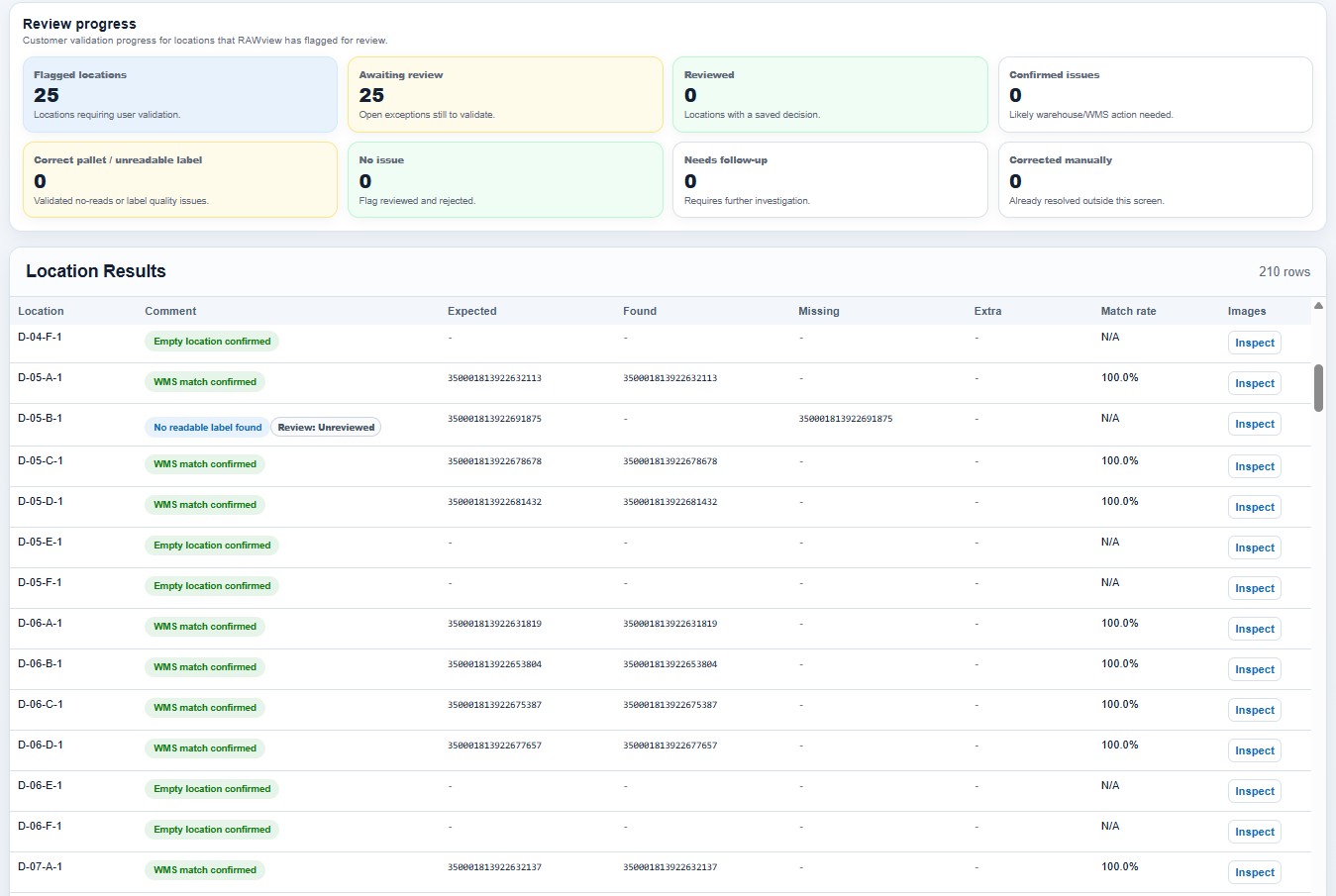
The physical result is then compared directly with the WMS expectation.
Possible results include:
Match
Expected inventory was found.
Missing inventory
The WMS expects inventory but it was not found.
Unexpected inventory
Stock was found where the WMS does not expect it.
Barcode mismatch
The location is occupied, but the inventory identifier differs from the expected record.
Unexpected occupied location
The WMS expects the position to be empty.
Unexpected empty location
The WMS expects stock but the position appears empty.
This structured comparison is more useful than simply counting the total number of items in an aisle.
4. Look for cross-location matches
This is particularly useful in pallet warehouses.
Suppose:
Location A should contain pallet ID 123.
Location B should contain pallet ID 456.
Physical verification finds pallet 456 in Location A, while Location B is empty.
Those two discrepancies should not necessarily be treated as unrelated. The unexpected pallet found in one position matches inventory that is missing from another. That strongly suggests a possible misplaced pallet.
A reconciliation process that considers the wider warehouse expectation can therefore provide better investigative clues than checking each location independently.
5. Review the evidence
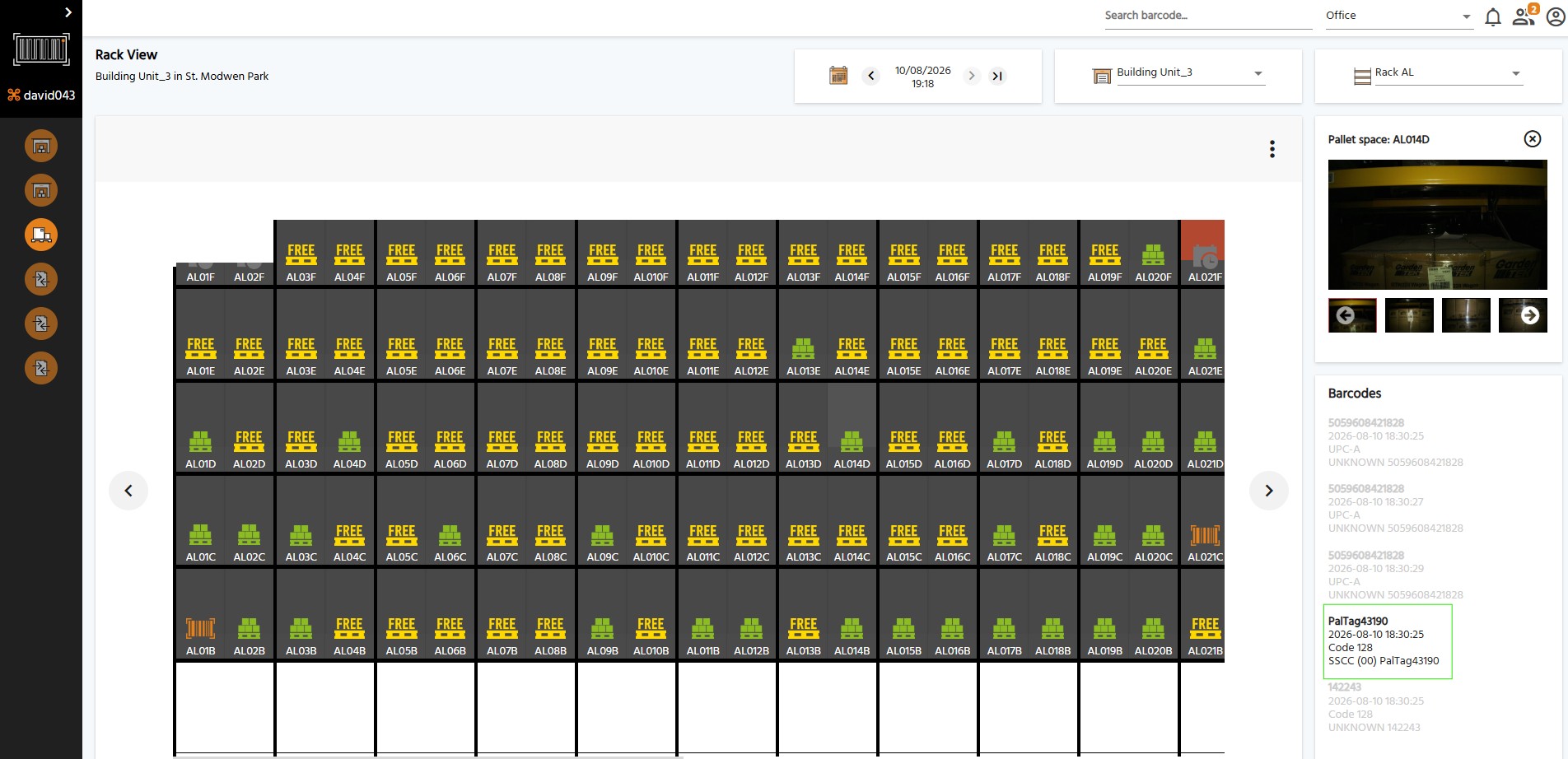
Where physical evidence is available, reconciliation becomes easier.
A time-stamped image may show:
- the pallet physically present
- the barcode scanned
- the condition or visibility of the label
- whether the location appeared empty
- nearby inventory
This can be particularly useful where the discrepancy is reviewed after the physical check took place.
Instead of sending somebody back to the location immediately, the stock-control team can inspect the evidence first.
6. Classify the exception
Not every mismatch means the same thing. A useful reconciliation workflow allows the exception to be categorised.
For example:
- confirmed mismatch
- WMS correction required
- accepted difference
- needs warehouse investigation
- unreadable barcode
- likely misplaced pallet
- duplicate or incorrect label
- operationally resolved
Classification allows management to understand the types of discrepancy occurring across the warehouse.
7. Decide what needs to change
The reconciliation process should not assume that the system record is always wrong. Sometimes the physical observation needs further investigation.
For example, an unexpected pallet might genuinely be in the correct place because a movement occurred after the WMS extract was generated.
The right workflow therefore allows a human reviewer to determine the operational meaning of the exception.
Possible outcomes include:
- correct the WMS
- physically relocate inventory
- accept the difference
- investigate further
- correct a label
- close the exception with no change
8. Record the root cause
The final step should go beyond closing the discrepancy.
If possible, record the root cause. Repeated errors can then be grouped around areas such as:
- putaway
- replenishment
- scanning
- dispatch
- temporary movements
- labelling
- process compliance
That information can be far more valuable than the individual inventory adjustment.
Root cause analysis is one of the key controls required to improve warehouse inventory accuracy over time.
Inventory reconciliation vs inventory adjustment
These terms should not be treated as interchangeable.
Inventory adjustment changes a system record.
Inventory reconciliation determines why the system and physical inventory differ and establishes the correct outcome.
An adjustment may be part of reconciliation, but it should not automatically be the entire process.
If stock-control teams repeatedly correct discrepancies without understanding why they're occurring in the first place, the same underlying problem can continue indefinitely.
How often should inventory reconciliation happen?
Ideally, reconciliation should happen as close as practical to the physical verification event. The longer the delay, the harder the investigation becomes.
If a discrepancy is discovered today using data that reflects yesterday's warehouse state, the investigation window is small.
If the discrepancy relates to a physical check completed months ago, transaction history and physical conditions have probably changed substantially.
Frequent verification therefore improves reconciliation as well as inventory accuracy.
Manual inventory reconciliation can become a bottleneck
Large warehouses can generate significant amounts of physical inventory data. If every check has to be exported, manually compared, investigated and documented in spreadsheets, the reconciliation workload can quickly become a constraint.
This is one reason simply increasing the number of manual counts does not always improve inventory control.
The verification process also needs an efficient method of turning observations into actionable exceptions.
What automated reconciliation should do
A useful automated inventory reconciliation workflow should:
- import or receive WMS expectations
- associate them with warehouse locations
- capture physical observations
- compare expected and observed inventory
- highlight discrepancies
- retain supporting evidence
- identify potential cross-location mismatches
- allow human review
- record the final decision
- preserve an audit trail
The objective is not to remove human judgement; it is to remove unnecessary manual comparison work so people can concentrate on the exceptions that actually need a decision.
Reconciliation closes the Inventory Assurance Gap
A physical warehouse check provides evidence.
The WMS provides expectation.
Reconciliation connects the two.
Without that comparison, the organisation may collect large amounts of inventory data without actually knowing where physical reality differs from the system.
This is why reconciliation is a central part of inventory assurance. It turns physical verification into a repeatable operational control.
RAWview's free Inventory Assurance Health Check assesses how effectively physical verification, reconciliation and exception management are currently working together in your warehouse.
Frequently asked questions
What is inventory reconciliation in a warehouse?
Inventory reconciliation is the process of comparing physical inventory with WMS or ERP records, identifying any differences and determining the correct action required to resolve each discrepancy.
What is the difference between inventory reconciliation and cycle counting?
Cycle counting is the physical verification activity. Reconciliation is the process of comparing the physical result with system expectations and resolving the differences.
How do you reconcile warehouse inventory?
Start with the WMS expectation, physically verify inventory, compare the two, classify discrepancies, investigate exceptions, make any required corrections and record the root cause.
Can inventory reconciliation be automated?
Much of the comparison and exception identification process can be automated. Human review is still valuable for deciding what individual discrepancies mean operationally and what corrective action should be taken.

Inventory reconciliation sounds simple - Compare the Warehouse Management System with the physical stock, identify the differences and correct them.
In practice, the most valuable part of reconciliation is not changing the number in the system; it's understanding why the WMS and physical warehouse stopped agreeing in the first place.
That understanding is what turns inventory reconciliation from an admin exercise into proper operational control.
What is warehouse inventory reconciliation?
Warehouse inventory reconciliation is the process of comparing recorded inventory with physically observed inventory and resolving any differences.
For a pallet warehouse, that normally means comparing:
Expected by the WMS
against:
Actually found in the location
A matching result confirms the record, whilst a non-matching result creates an exception.
That exception might be:
- expected pallet missing
- unexpected pallet found
- wrong pallet in the location
- location expected to be empty but occupied
- location expected to be occupied but empty
- unreadable or unidentified inventory
- quantity difference
The reconciliation process determines what those differences mean and what should happen next.
Why inventory reconciliation matters
Warehouse discrepancies create operational uncertainty. If the physical warehouse and the WMS do not agree, people start asking questions.
Where is the pallet?
Was it moved?
Was it dispatched?
Is the location wrong?
Was the wrong barcode scanned?
Does the WMS need correcting?
The faster the business can answer those questions, the less disruption the discrepancy creates.
Good reconciliation therefore improves more than inventory accuracy.
It can reduce:
- pallet searching time
- failed picks
- replenishment delays
- customer disputes
- emergency stock counts
- unnecessary system adjustments
The warehouse inventory reconciliation process
1. Establish the expected inventory position
Start with the authoritative WMS or ERP record - for each location being verified, establish what the system actually expects to be present.
For a pallet operation that may include:
- location ID
- pallet or SSCC number
- SKU
- quantity
- expected empty status
- customer
The system expectation should be considered the baseline.
2. Capture the physical reality
Next, physically verify the location. The objective here is to establish what is genuinely present rather than what the system believes should be there.
Depending on the warehouse, this might be captured using:
- handheld barcode scanning
- manual stock counting
- fixed scanning systems
- autonomous inventory verification
- photographic evidence
The physical observation should ideally include a location reference and timestamp.
3. Compare expected vs observed
The physical result is then compared directly with the WMS expectation.
Possible results include:
Match
Expected inventory was found.
Missing inventory
The WMS expects inventory but it was not found.
Unexpected inventory
Stock was found where the WMS does not expect it.
Barcode mismatch
The location is occupied, but the inventory identifier differs from the expected record.
Unexpected occupied location
The WMS expects the position to be empty.
Unexpected empty location
The WMS expects stock but the position appears empty.
This structured comparison is more useful than simply counting the total number of items in an aisle.
4. Look for cross-location matches
This is particularly useful in pallet warehouses.
Suppose:
Location A should contain pallet ID 123.
Location B should contain pallet ID 456.
Physical verification finds pallet 456 in Location A, while Location B is empty.
Those two discrepancies should not necessarily be treated as unrelated. The unexpected pallet found in one position matches inventory that is missing from another. That strongly suggests a possible misplaced pallet.
A reconciliation process that considers the wider warehouse expectation can therefore provide better investigative clues than checking each location independently.
5. Review the evidence
Where physical evidence is available, reconciliation becomes easier.
A time-stamped image may show:
- the pallet physically present
- the barcode scanned
- the condition or visibility of the label
- whether the location appeared empty
- nearby inventory
This can be particularly useful where the discrepancy is reviewed after the physical check took place.
Instead of sending somebody back to the location immediately, the stock-control team can inspect the evidence first.
6. Classify the exception
Not every mismatch means the same thing. A useful reconciliation workflow allows the exception to be categorised.
For example:
- confirmed mismatch
- WMS correction required
- accepted difference
- needs warehouse investigation
- unreadable barcode
- likely misplaced pallet
- duplicate or incorrect label
- operationally resolved
Classification allows management to understand the types of discrepancy occurring across the warehouse.
7. Decide what needs to change
The reconciliation process should not assume that the system record is always wrong. Sometimes the physical observation needs further investigation.
For example, an unexpected pallet might genuinely be in the correct place because a movement occurred after the WMS extract was generated.
The right workflow therefore allows a human reviewer to determine the operational meaning of the exception.
Possible outcomes include:
- correct the WMS
- physically relocate inventory
- accept the difference
- investigate further
- correct a label
- close the exception with no change
8. Record the root cause
The final step should go beyond closing the discrepancy.
If possible, record the root cause. Repeated errors can then be grouped around areas such as:
- putaway
- replenishment
- scanning
- dispatch
- temporary movements
- labelling
- process compliance
That information can be far more valuable than the individual inventory adjustment.
Root cause analysis is one of the key controls required to improve warehouse inventory accuracy over time.
Inventory reconciliation vs inventory adjustment
These terms should not be treated as interchangeable.
Inventory adjustment changes a system record.
Inventory reconciliation determines why the system and physical inventory differ and establishes the correct outcome.
An adjustment may be part of reconciliation, but it should not automatically be the entire process.
If stock-control teams repeatedly correct discrepancies without understanding why they're occurring in the first place, the same underlying problem can continue indefinitely.
How often should inventory reconciliation happen?
Ideally, reconciliation should happen as close as practical to the physical verification event. The longer the delay, the harder the investigation becomes.
If a discrepancy is discovered today using data that reflects yesterday's warehouse state, the investigation window is small.
If the discrepancy relates to a physical check completed months ago, transaction history and physical conditions have probably changed substantially.
Frequent verification therefore improves reconciliation as well as inventory accuracy.
Manual inventory reconciliation can become a bottleneck
Large warehouses can generate significant amounts of physical inventory data. If every check has to be exported, manually compared, investigated and documented in spreadsheets, the reconciliation workload can quickly become a constraint.
This is one reason simply increasing the number of manual counts does not always improve inventory control.
The verification process also needs an efficient method of turning observations into actionable exceptions.
What automated reconciliation should do
A useful automated inventory reconciliation workflow should:
- import or receive WMS expectations
- associate them with warehouse locations
- capture physical observations
- compare expected and observed inventory
- highlight discrepancies
- retain supporting evidence
- identify potential cross-location mismatches
- allow human review
- record the final decision
- preserve an audit trail
The objective is not to remove human judgement; it is to remove unnecessary manual comparison work so people can concentrate on the exceptions that actually need a decision.
Reconciliation closes the Inventory Assurance Gap
A physical warehouse check provides evidence.
The WMS provides expectation.
Reconciliation connects the two.
Without that comparison, the organisation may collect large amounts of inventory data without actually knowing where physical reality differs from the system.
This is why reconciliation is a central part of inventory assurance. It turns physical verification into a repeatable operational control.
RAWview's free Inventory Assurance Health Check assesses how effectively physical verification, reconciliation and exception management are currently working together in your warehouse.
Frequently asked questions
What is inventory reconciliation in a warehouse?
Inventory reconciliation is the process of comparing physical inventory with WMS or ERP records, identifying any differences and determining the correct action required to resolve each discrepancy.
What is the difference between inventory reconciliation and cycle counting?
Cycle counting is the physical verification activity. Reconciliation is the process of comparing the physical result with system expectations and resolving the differences.
How do you reconcile warehouse inventory?
Start with the WMS expectation, physically verify inventory, compare the two, classify discrepancies, investigate exceptions, make any required corrections and record the root cause.
Can inventory reconciliation be automated?
Much of the comparison and exception identification process can be automated. Human review is still valuable for deciding what individual discrepancies mean operationally and what corrective action should be taken.
Client Testimonial


