
Why WMS Records Don’t Match Physical Inventory
Learn why warehouse stock drifts from WMS records, how the Inventory Assurance Gap creates operational risk and how independent verification closes it.
Independent Verification of Physical Inventory Accuracy
Most warehouses operate on the assumption that inventory recorded in their Warehouse Management System accurately reflects physical reality. In practice, this assumption often goes unchallenged until a problem arises.
The Inventory Assurance Gap describes the difference between what the system believes is present and what is physically verified on the warehouse floor. This page explains why that gap exists, why it matters and how it can be closed without disrupting live operations.
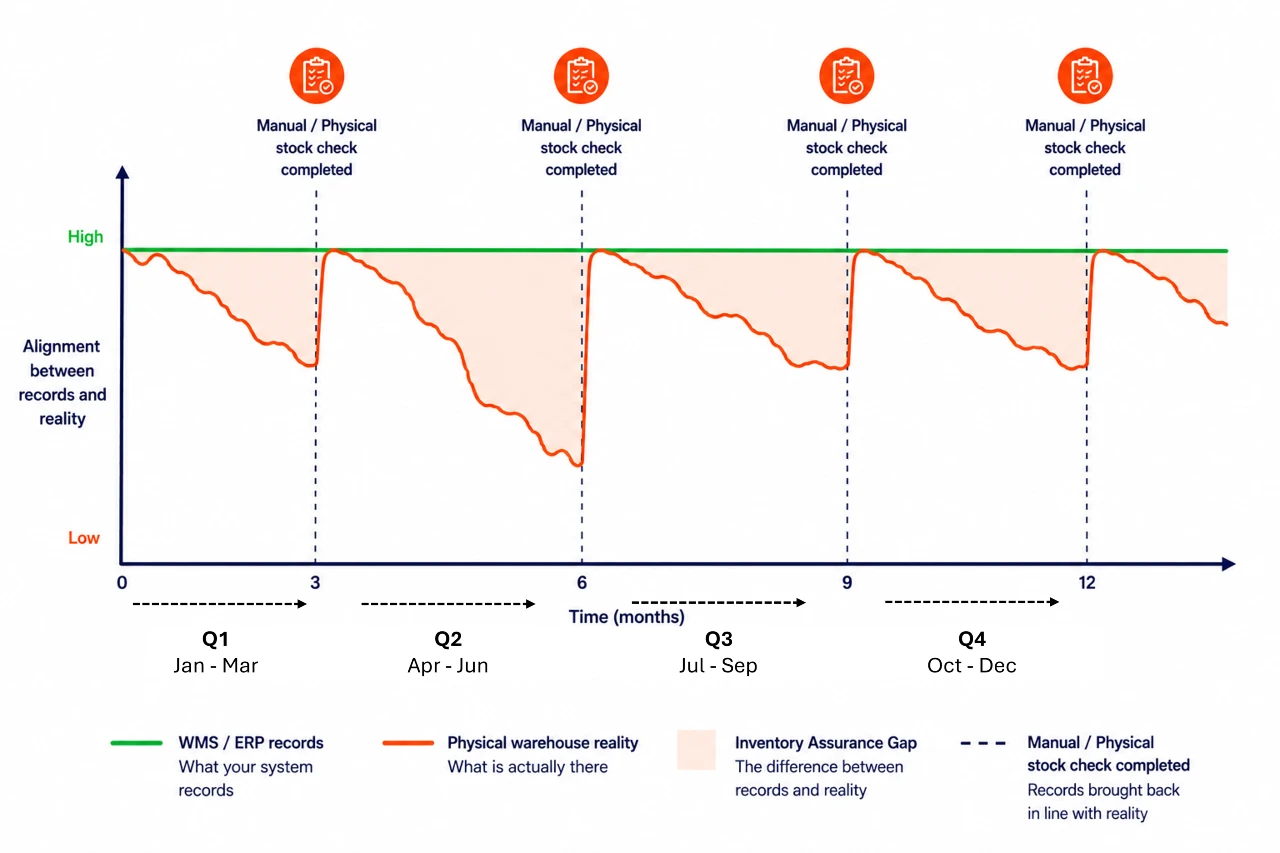
How the Inventory Assurance Gap develops over time
The WMS assumes inventory accuracy remains consistent week in, week out. In reality, physical accuracy gradually drifts as day-to-day operations introduce errors, creating what we call the Inventory Assurance Gap. Manual audits uncover these discrepancies and temporarily close the gap, but accuracy soon declines again, leaving extended periods where actual inventory accuracy is materially lower than the WMS indicates. It is within this Inventory Assurance Gap that operational risk accumulates.
Where the Inventory Assurance Gap shows up in practice
The Inventory Assurance Gap rarely presents itself as a single, obvious problem. Instead, it typically surfaces through a set of recurring operational risks - all driven by the absence of continuous, independent verification of physical inventory.
The most common areas where this gap becomes visible include:
Audit risk
Inventory discrepancies often remain hidden until audits, reconciliations, or compliance reviews force physical verification. When errors surface late, they are costly to investigate and difficult to defend.
Inventory disputes
When system records and physical reality diverge, disputes arise - with customers, internal teams, or finance. Without independent verification, resolving these disputes becomes reactive, time-consuming and credibility-eroding.
Manual stock count limitations
Periodic stock counts validate records at a single point in time, but they do not provide ongoing assurance. Errors are often corrected temporarily, only to reappear between counts.
Change risk
Warehouse moves, re-slotting, layout changes, system migrations and process redesigns frequently expose inaccuracies that have accumulated over time. Without continuous verification, operational change amplifies risk rather than revealing it early.
The Problem with Assumed Inventory Accuracy
Warehouse Management Systems are highly effective at tracking transactions, movements and status changes.
However, they are not designed to independently confirm whether a pallet is physically present, correctly located or still intact over time.
As a result, inventory accuracy is often assumed, not continuously verified.
Over weeks and months, small discrepancies accumulate:
- Misplaced pallets go unnoticed
- Empty locations remain marked as full
- Shrinkage and handling errors are discovered late
- Confidence in inventory data erodes quietly
Without independent verification, errors tend to surface only during audits, customer disputes or operational failures.
What the Inventory Assurance Gap Looks Like in Practice
In most warehouses, the assurance gap is not caused by a single failure, but by the absence of continuous confirmation. Common examples include:
Pallets recorded in a location but physically missing
Stock moved during peak operations without system reconciliation
Locations counted during cycle counts but not visually verified
Errors corrected temporarily, then reintroduced over time
Because these issues are intermittent and distributed, they are difficult to detect through sampling or periodic stocktakes alone.
Why Manual Processes Struggle to Close the Gap
Traditional approaches to improving inventory accuracy rely on manual intervention:
- Wall-to-Wall stocktakes
- Cycle counts
- Ad-hoc checks following incidents
While necessary, these methods are:
- Periodic rather than continuous
- Labour-intensive and disruptive
- Dependent on working at height
- Focused on correcting data, not verifying reality
As a result, they tend to validate records rather than provide ongoing assurance that physical inventory remains correct between checks.
Closing the Inventory Assurance Gap
Closing the Inventory Assurance Gap requires independent, repeatable verification of physical inventory positions.
Rather than replacing existing systems, independent verification operates alongside your Warehouse Management System to confirm that physical inventory continues to match system records over time.
Key characteristics include:
- Objective verification of physical pallet locations
- Repeatable coverage without operational disruption
- Clear identification of discrepancies rather than inferred accuracy
- Verified outputs that support decision-making across operations, finance and audit
This approach shifts inventory control from assumed accuracy to demonstrated assurance.
What Changes When the Gap is Closed
When physical inventory is independently verified on an ongoing basis, organisations typically experience:
- Increased confidence in inventory data
- Earlier identification of discrepancies
- Reduced reliance on disruptive stocktake activity
- Improved audit readiness and compliance support
- More predictable operational planning
Most importantly, inventory accuracy becomes a controlled outcome, not an assumption.
How this Relates to Independent Inventory Verification
The Inventory Assurance Gap explains why independent verification is required.
Details on how independent inventory verification is delivered as a managed service - including operational deployment, responsibilities and outputs - are explained on our Warehouse Management page.
Independent verification provides the mechanism through which the assurance gap is closed in live warehouse environments.
Discuss Your Inventory Assurance Requirements
If you’re evaluating how to improve confidence in inventory accuracy without disrupting live operations, we can help you assess your current assurance gap and determine whether independent verification is appropriate for your environment.