
How Often Should You Cycle Count Warehouse Inventory?
How often should warehouse inventory be cycle counted?
Daily?
Weekly?
Monthly?
Quarterly?
The temptation is to look for a standard frequency.
In reality, the right answer depends on the amount of inventory risk the operation is prepared to carry.
A more useful way to design a cycle count programme is to ask:
How long can we afford for a discrepancy to exist before we discover it?
That changes cycle counting from a calendar exercise into a risk control decision.
Why cycle count frequency matters
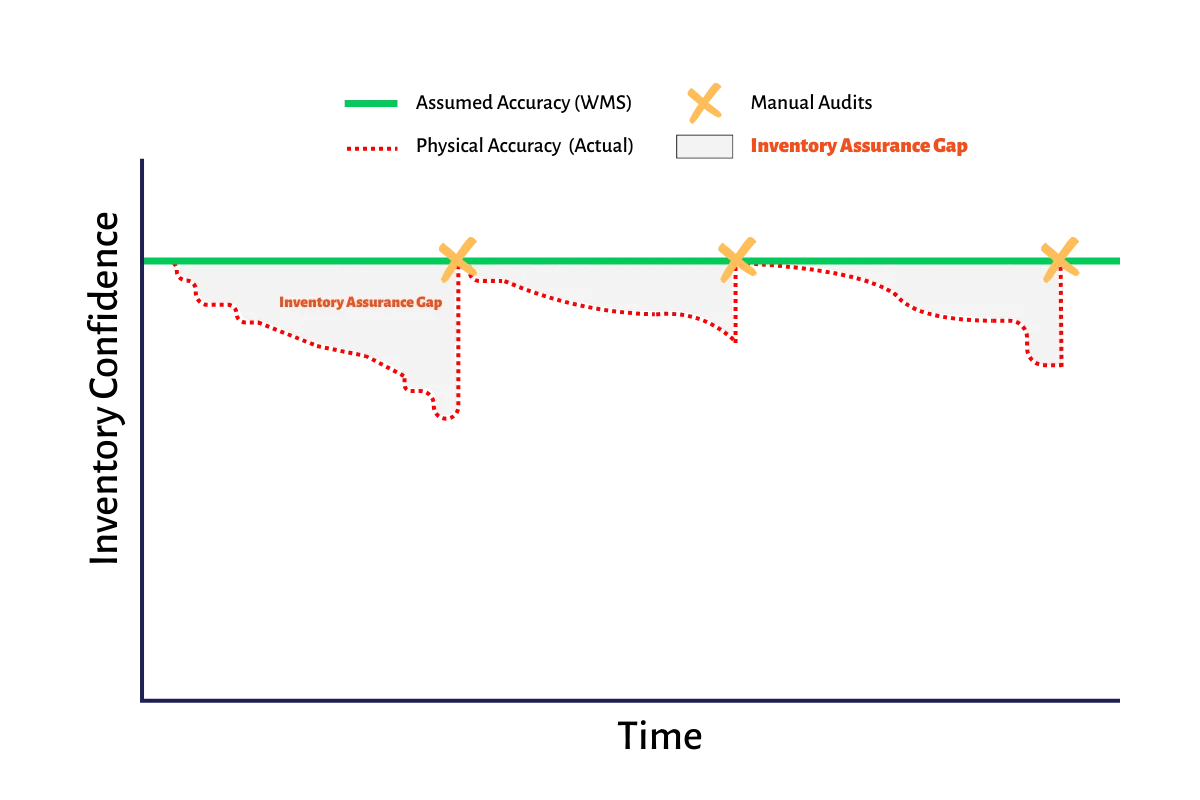
Inventory discrepancies are not created on stocktake day; they develop during normal warehouse operations.
A pallet is placed in the wrong location. A movement is not recorded correctly. A barcode is damaged. An expected-empty location becomes occupied. A replenishment transaction goes wrong.
The longer the interval before the next physical check, the longer that discrepancy can remain hidden.
If a location is physically verified once every four months, a newly created error could theoretically exist for almost four months before that control finds it.
If the same location is verified weekly, the exposure window is dramatically shorter.
This is why frequency matters.
There is no single correct cycle count frequency
Different parts of the same warehouse may justify different frequencies.
A slow-moving reserve area does not necessarily carry the same risk as a high-velocity replenishment zone.
Likewise, a pallet holding high-value stock may warrant more frequent verification than one carrying low-risk inventory.
A sensible cycle counting strategy therefore considers several factors.
1. Inventory movement frequency
The more often stock moves, the more opportunities there are for physical and system records to become misaligned.
High-velocity areas may therefore warrant more frequent checks.
This does not imply that every movement is unreliable - it simply recognises that a process repeated thousands of times creates more opportunities for exceptions than one performed occasionally.
2. Consequence of a discrepancy
Not every inventory error has the same impact.
If one misplaced pallet could stop production, breach a customer SLA or create a significant write-off, the business may decide that the location requires a shorter verification interval.
Frequency should therefore reflect consequence as well as likelihood.
3. Historical discrepancy rate
Past exceptions can help direct future verification.
If particular aisles, products, shifts, processes or location types produce disproportionately high numbers of discrepancies, additional checking can help identify whether corrective actions are working.
A mature programme therefore uses cycle counts not just to correct inventory but to learn where the operation is most vulnerable.
4. Customer and contractual requirements
For 3PLs and contract-logistics operations, verification frequency may be influenced by customer commitments.
A customer may require a particular proportion of inventory to be checked within a given period.
In that situation, the cycle count programme becomes part of the service being delivered, not merely an internal warehouse process.
Coverage evidence becomes especially important.
5. Audit and financial risk
Higher-value inventory or areas that regularly create reconciliation questions may justify more frequent checks.
The objective is to avoid discovering a long history of unexplained discrepancies only when the formal audit begins.
More frequent physical evidence can narrow investigation windows and improve confidence in the records being relied upon.
6. Accessibility
Accessibility often has too much influence on actual cycle count frequency.
Ground-level stock gets checked because it is easy, whereas high-level stock gets checked less frequently because it requires more time, equipment or safety controls.
That is understandable operationally, but it creates an inventory control weakness.
Risk should determine verification frequency, not convenience.
If an important pallet is stored twelve metres in the air, the business should not automatically have less confidence in it simply because it is harder for a person to reach.
What is the discrepancy detection window?
The discrepancy detection window is the period during which a new inventory error could remain undetected by the normal physical-verification process.
It is a useful way of thinking about cycle count frequency.
Suppose an aisle is checked once every 90 days.
Immediately after today's count, an inventory error occurs.
Unless another process exposes it, that discrepancy could remain undiscovered until the next scheduled check.
In this scenario, the maximum detection window is therefore approximately 90 days.
Reducing that interval reduces the amount of time the operation is relying on a potentially inaccurate inventory position.
Should every warehouse location be counted equally often?
Not necessarily. Risk-based cycle counting can be entirely appropriate, but there is a difference between deliberately assigning different verification frequencies and unintentionally ignoring parts of the warehouse.
A structured approach might use tiers, such as:
Higher-frequency verification
Suitable for locations with:
- high inventory velocity
- high-value stock
- frequent historical discrepancies
- significant customer or production consequences
- critical replenishment activity
Standard-frequency verification
Suitable for stable areas where inventory moves predictably and historical discrepancy rates are low.
Lower-frequency verification
Potentially appropriate for genuinely low-risk, slow-moving stock — provided those locations still remain within the overall control framework.
The important point is that the frequency should be intentional, measured and reviewed.
Why planned frequency and completed frequency are different
A warehouse may have an excellent cycle-count schedule on paper.
What matters is whether those checks actually happen.
Operational priorities can intervene.
People are reassigned. Aisles are busy. Access equipment is unavailable. Peak volume takes precedence.
If this happens repeatedly, actual verification coverage can fall well below the planned programme.
Stock control teams should therefore track:
- planned locations
- completed locations
- overdue locations
- date of last physical verification
- high-level versus low-level coverage
That shows whether the control is genuinely operating.
When manual cycle counting reaches its practical limit
There is a point where increasing frequency manually becomes difficult.
- More counts require more labour.
- High-level counts may require more equipment.
- Counting activity may compete with productive warehouse work.
This is often why organisations tolerate longer verification intervals than they would ideally choose.
Autonomous inventory verification changes that constraint by separating physical data capture from manual stock control effort.
The question moves from:
“How many locations can our team physically count?”
towards:
“How frequently do we want physical inventory to be verified?”
That is a much healthier starting point for inventory control design.
From counting frequency to inventory assurance
The strongest cycle count programmes combine frequency with coverage and reconciliation.
Checking the same easy locations every week does not create strong assurance if half the warehouse remains unverified.
Likewise, checking everything frequently is less useful if discrepancies are simply corrected without investigation. That is why improving inventory accuracy requires root cause control as well as more counting.
Strong inventory assurance requires:
- meaningful physical coverage
- appropriate verification frequency
- objective evidence
- comparison with WMS expectations
- clear exception ownership
- management visibility
Cycle count frequency is therefore one part of a wider control system.
How strong is your current cycle count programme?
If your warehouse already performs manual cycle counts, the question is not whether you count inventory.
It is whether the frequency and coverage of those checks are sufficient for the risks you are trying to control. RAWview's free Inventory Assurance Health Check provides a structured way to assess that.
Those are also important questions when assessing overall warehouse inventory audit readiness.
Frequently asked questions
How often should warehouse inventory be cycle counted?
There is no universal frequency. The interval should reflect inventory velocity, discrepancy history, operational consequence, customer requirements and the amount of time the business can tolerate an error remaining undiscovered.
Should high-value inventory be counted more frequently?
Often, yes. Risk-based cycle counting typically gives higher-value or operationally critical inventory a shorter verification interval because the consequence of an undetected discrepancy is greater.
How can a warehouse increase cycle count frequency without adding labour?
Reducing manual data-capture effort through automated or autonomous verification can increase physical-check capacity while allowing stock-control teams to focus on discrepancy investigation and resolution.

How often should warehouse inventory be cycle counted?
Daily?
Weekly?
Monthly?
Quarterly?
The temptation is to look for a standard frequency.
In reality, the right answer depends on the amount of inventory risk the operation is prepared to carry.
A more useful way to design a cycle count programme is to ask:
How long can we afford for a discrepancy to exist before we discover it?
That changes cycle counting from a calendar exercise into a risk control decision.
Why cycle count frequency matters
Inventory discrepancies are not created on stocktake day; they develop during normal warehouse operations.
A pallet is placed in the wrong location. A movement is not recorded correctly. A barcode is damaged. An expected-empty location becomes occupied. A replenishment transaction goes wrong.
The longer the interval before the next physical check, the longer that discrepancy can remain hidden.
If a location is physically verified once every four months, a newly created error could theoretically exist for almost four months before that control finds it.
If the same location is verified weekly, the exposure window is dramatically shorter.
This is why frequency matters.
There is no single correct cycle count frequency
Different parts of the same warehouse may justify different frequencies.
A slow-moving reserve area does not necessarily carry the same risk as a high-velocity replenishment zone.
Likewise, a pallet holding high-value stock may warrant more frequent verification than one carrying low-risk inventory.
A sensible cycle counting strategy therefore considers several factors.
1. Inventory movement frequency
The more often stock moves, the more opportunities there are for physical and system records to become misaligned.
High-velocity areas may therefore warrant more frequent checks.
This does not imply that every movement is unreliable - it simply recognises that a process repeated thousands of times creates more opportunities for exceptions than one performed occasionally.
2. Consequence of a discrepancy
Not every inventory error has the same impact.
If one misplaced pallet could stop production, breach a customer SLA or create a significant write-off, the business may decide that the location requires a shorter verification interval.
Frequency should therefore reflect consequence as well as likelihood.
3. Historical discrepancy rate
Past exceptions can help direct future verification.
If particular aisles, products, shifts, processes or location types produce disproportionately high numbers of discrepancies, additional checking can help identify whether corrective actions are working.
A mature programme therefore uses cycle counts not just to correct inventory but to learn where the operation is most vulnerable.
4. Customer and contractual requirements
For 3PLs and contract-logistics operations, verification frequency may be influenced by customer commitments.
A customer may require a particular proportion of inventory to be checked within a given period.
In that situation, the cycle count programme becomes part of the service being delivered, not merely an internal warehouse process.
Coverage evidence becomes especially important.
5. Audit and financial risk
Higher-value inventory or areas that regularly create reconciliation questions may justify more frequent checks.
The objective is to avoid discovering a long history of unexplained discrepancies only when the formal audit begins.
More frequent physical evidence can narrow investigation windows and improve confidence in the records being relied upon.
6. Accessibility
Accessibility often has too much influence on actual cycle count frequency.
Ground-level stock gets checked because it is easy, whereas high-level stock gets checked less frequently because it requires more time, equipment or safety controls.
That is understandable operationally, but it creates an inventory control weakness.
Risk should determine verification frequency, not convenience.
If an important pallet is stored twelve metres in the air, the business should not automatically have less confidence in it simply because it is harder for a person to reach.
What is the discrepancy detection window?
The discrepancy detection window is the period during which a new inventory error could remain undetected by the normal physical-verification process.
It is a useful way of thinking about cycle count frequency.
Suppose an aisle is checked once every 90 days.
Immediately after today's count, an inventory error occurs.
Unless another process exposes it, that discrepancy could remain undiscovered until the next scheduled check.
In this scenario, the maximum detection window is therefore approximately 90 days.
Reducing that interval reduces the amount of time the operation is relying on a potentially inaccurate inventory position.
Should every warehouse location be counted equally often?
Not necessarily. Risk-based cycle counting can be entirely appropriate, but there is a difference between deliberately assigning different verification frequencies and unintentionally ignoring parts of the warehouse.
A structured approach might use tiers, such as:
Higher-frequency verification
Suitable for locations with:
- high inventory velocity
- high-value stock
- frequent historical discrepancies
- significant customer or production consequences
- critical replenishment activity
Standard-frequency verification
Suitable for stable areas where inventory moves predictably and historical discrepancy rates are low.
Lower-frequency verification
Potentially appropriate for genuinely low-risk, slow-moving stock — provided those locations still remain within the overall control framework.
The important point is that the frequency should be intentional, measured and reviewed.
Why planned frequency and completed frequency are different
A warehouse may have an excellent cycle-count schedule on paper.
What matters is whether those checks actually happen.
Operational priorities can intervene.
People are reassigned. Aisles are busy. Access equipment is unavailable. Peak volume takes precedence.
If this happens repeatedly, actual verification coverage can fall well below the planned programme.
Stock control teams should therefore track:
- planned locations
- completed locations
- overdue locations
- date of last physical verification
- high-level versus low-level coverage
That shows whether the control is genuinely operating.
When manual cycle counting reaches its practical limit
There is a point where increasing frequency manually becomes difficult.
- More counts require more labour.
- High-level counts may require more equipment.
- Counting activity may compete with productive warehouse work.
This is often why organisations tolerate longer verification intervals than they would ideally choose.
Autonomous inventory verification changes that constraint by separating physical data capture from manual stock control effort.
The question moves from:
“How many locations can our team physically count?”
towards:
“How frequently do we want physical inventory to be verified?”
That is a much healthier starting point for inventory control design.
From counting frequency to inventory assurance
The strongest cycle count programmes combine frequency with coverage and reconciliation.
Checking the same easy locations every week does not create strong assurance if half the warehouse remains unverified.
Likewise, checking everything frequently is less useful if discrepancies are simply corrected without investigation. That is why improving inventory accuracy requires root cause control as well as more counting.
Strong inventory assurance requires:
- meaningful physical coverage
- appropriate verification frequency
- objective evidence
- comparison with WMS expectations
- clear exception ownership
- management visibility
Cycle count frequency is therefore one part of a wider control system.
How strong is your current cycle count programme?
If your warehouse already performs manual cycle counts, the question is not whether you count inventory.
It is whether the frequency and coverage of those checks are sufficient for the risks you are trying to control. RAWview's free Inventory Assurance Health Check provides a structured way to assess that.
Those are also important questions when assessing overall warehouse inventory audit readiness.
Frequently asked questions
How often should warehouse inventory be cycle counted?
There is no universal frequency. The interval should reflect inventory velocity, discrepancy history, operational consequence, customer requirements and the amount of time the business can tolerate an error remaining undiscovered.
Should high-value inventory be counted more frequently?
Often, yes. Risk-based cycle counting typically gives higher-value or operationally critical inventory a shorter verification interval because the consequence of an undetected discrepancy is greater.
How can a warehouse increase cycle count frequency without adding labour?
Reducing manual data-capture effort through automated or autonomous verification can increase physical-check capacity while allowing stock-control teams to focus on discrepancy investigation and resolution.
Client Testimonial


